Ask a prospective applicant why they want Caribbean citizenship and the answer almost always comes back to mobility. How many countries, which airports, whether Schengen is included. The industry has trained its clients to shop this way, ranking programs the way one ranks credit cards, by counting the perks.
Grenada scores well on that test. Its passport grants access to the Schengen Area, the UK, Singapore, Hong Kong, and, uniquely among Caribbean programs, China.

But the test itself is flawed because visa policy is set by other governments, and those governments can rewrite it. Anyone following the industry over the past year knows how quickly access maps shift with politics.
What no third country can rewrite is the value underneath: the legal status itself. A second nationality is a bundle of rights under Grenadian law, and those rights are the product. The travel document is just the accessory that comes with it.
Read that way, Grenada’s citizenship holds up better than almost anything else in the market. Here is what the status actually contains.
The American Gateway
Grenada is the only Caribbean CBI jurisdiction whose citizens qualify for the US E-2 treaty investor visa under a 1987 bilateral treaty of commerce.
The E-2 allows a treaty national to live in the United States to direct and develop a genuine business, with a spouse authorized to work, and is renewable indefinitely at a fraction of the capital required by the EB-5 program. The visa is better suited for business owners and entrpeneurs who seek to launch or run businesses in the US, as opposed to the passive investment that EB-5 requires.
The EB-5 program starts at $800,000. The E-2 carries no statutory minimum, and attorneys typically advise committing $100,000 or more to a credible enterprise.
Run the arithmetic and the combination becomes striking: a Grenada CBI contribution of $235,000 plus an E-2 qualifying investment gives a family a second citizenship and a renewable route to live and work in the United States for well under half the capital EB-5 demands.
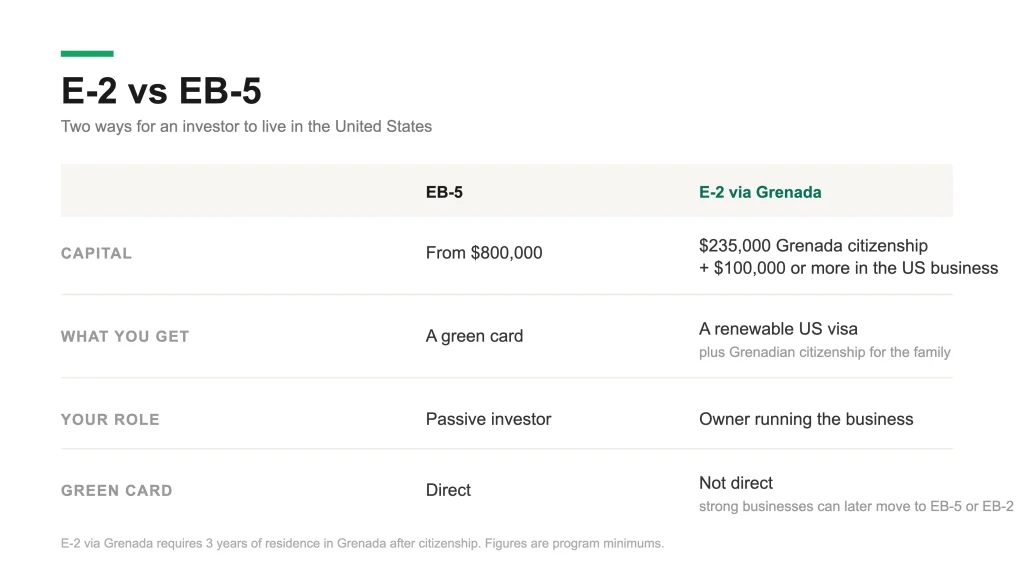
Under the 2022 AMIGOS Act, US law now requires anyone who acquired their treaty nationality through financial investment to demonstrate three years of continuous domicile in Grenada before applying for an E-2 visa.
The era of collecting a passport and filing an E-2 petition the following month is over.Three years of domicile means a residence, a local financial life, and sustained presence on the island.
Families who intend to build that kind of connection keep full access to the treaty. A structuring question also belongs in any serious consultation: the domicile rule attaches to citizenship acquired through investment, so a spouse who acquires Grenadian citizenship by registration through marriage may sit outside it.
One distinction is easy to miss: the E-2 is a nonimmigrant visa, which means it renews for as long as the business operates but never becomes a green card on its own, and time spent in E-2 status doesn’t count toward permanent residence.
This is why the route suits entrepreneurs and business owners best. A growing E-2 company builds the exact record that successful green card petitions are built on, so owners can later scale their investment into EB-5, or self-petition under the EB-2 National Interest Waiver if the business creates enough jobs or economic value.
Tax Residence as an Option, Not an Obligation
Grenadian citizenship imposes no tax obligations whatsoever. The country operates a territorial system: no tax on worldwide income, no capital gains tax, no inheritance or estate tax, no wealth tax. A citizen who never sets foot on the island owes Grenada nothing.
What the citizenship creates is optionality. A citizen who chooses to establish tax residence, generally by spending 183 days a year in the country, brings their global affairs under one of the most benign personal tax regimes in the hemisphere, with only Grenadian-source income taxable locally.
For internationally mobile families restructuring where they live and what they owe, that option sits within citizenship, exercisable whenever circumstances call for it, and ignorable when they do not.
A Citizenship You Can Bequeath
A passport expires every five years. A nationality does not expire at all, and Grenada’s is built to travel down generations.
Children born to Grenadian citizens acquire citizenship by descent automatically, and the transmission continues indefinitely: grandchildren and every subsequent generation qualify, with no residency requirement to maintain the status.
The initial application is equally generational. Grenada permits dependants, including children up to 30, parents and grandparents, and unmarried siblings, meaning three generations of one family can acquire the status in a single application.
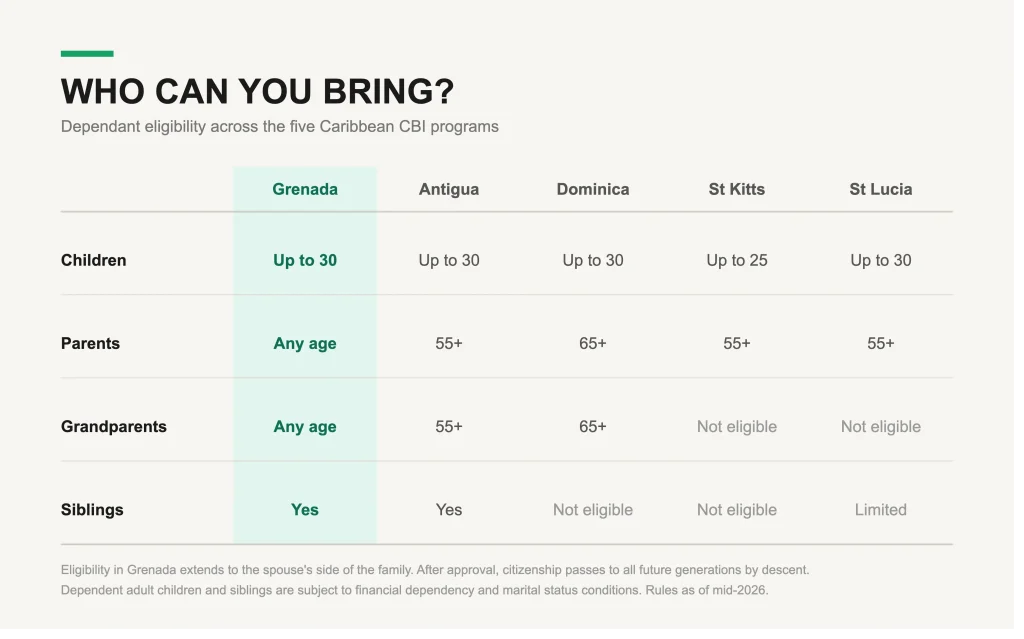
For families thinking in decades, this is the core of the product: not a travel perk for one applicant, but a permanent legal inheritance for a family line.
A Grenadian is also a citizen of the OECS Economic Union, with the right to live, work, and establish residence in any of the Eastern Caribbean’s member states without a visa, permit, or skills certificate.
Broader CARICOM rights extend the Community’s footprint across the Caribbean. One application, and a family’s legal standing spans a region rather than an island.
The Industry Is Catching Up to This Reading
Investment migration is in the middle of a structural shift, from selling travel documents to conferring citizenship as a relationship: genuine links, real presence, obligations alongside rights.
Regulators are demanding it, and programs across the world are rebuilding around it.
Grenada’s citizenship was always better suited to that second reading. The E-2 route now rewards genuine domicile. The tax option rewards genuine residence. The descent rules assume that a family intends to retain its nationality for generations.
Applicants who arrive asking only about visa-free travel are buying the least durable part of the product. Those who arrive asking about status, structure, and succession are buying the rest.
To structure Grenadian citizenship around what it actually is, a legal status with planning consequences across generations, contact Joseph Rowe Law, a full-service law firm practicing across five Caribbean jurisdictions from offices in St Kitts and Nevis, and Grenada.